

Research / Commentary
Defence inflation and the erosion of military capability
↓ Download PDF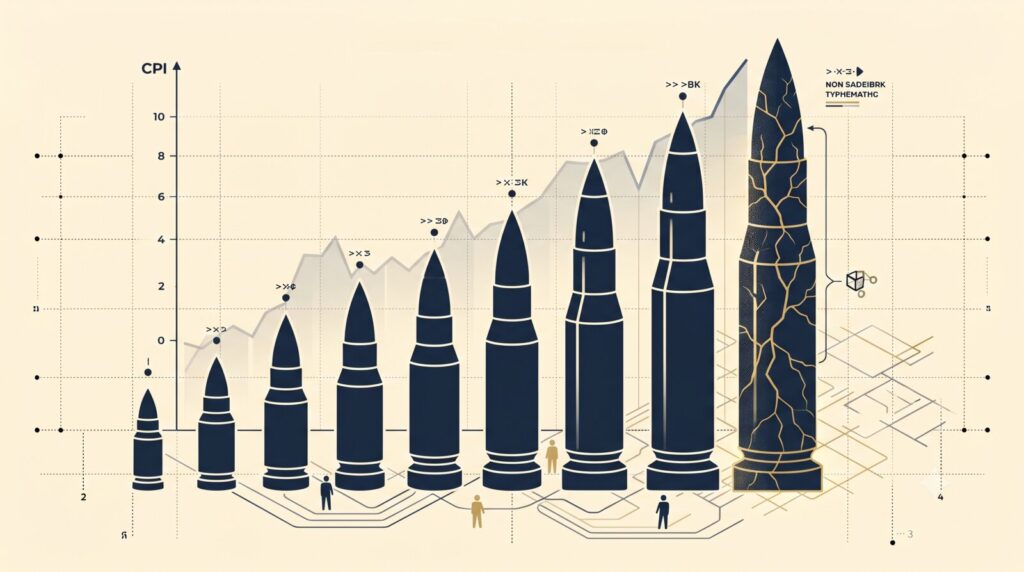

Artillery ammunition prices have risen several hundred percent since 2021. Dr. Rebecca Harding examines how defence inflation is quietly eroding NATO military capability — and why headline defence budgets no longer tell the whole story.
Dr. Rebecca Harding
Executive Summary
Defence inflation is structurally elevated:
- Widely estimated at approximately 6–10% annually for equipment
- Running 2–4 percentage points above CPI (EDA, 2025; NATO, 2024; NAO, 2024)
Cost increases are highly uneven across capability areas:
- Artillery ammunition: prices up several hundred percent since 2021 (approx. $2k → $6–8k+) (European Commission, 2023–2025; Defense One, 2023)
- Missiles / air defence systems: estimated +20–50% cost escalation (IISS, 2025; CSIS, 2025)
- Advanced electronics / semiconductors: +10–25% input cost pressures (OECD, 2025)
Extreme “scarcity pricing” is emerging in thin markets:
- Example: laser optics reportedly increased from around $20k to around $350k (increase of approx. +1,600%)
- Reflects limited suppliers and inelastic demand, not standard inflation dynamics
Nominal spending increases are being eroded in real terms:
- UK: +7% nominal vs 6–8% inflation → 0–1% real growth in expenditure
- US: +3–5% nominal vs 5–7% inflation → 0–2% real growth in expenditure
Defence inflation reflects a structural shift to a “preparedness economy”:
- Driven by synchronised rearmament, constrained capacity, and supply chain reconfiguration
- Consistent with Harding (2025a; 2025b), which emphasises that effectiveness depends on allocation as much as expenditure
The analysis suggests:
- A +10% budget increase with around 8% inflation delivers a 2% real capability gain
- In high-inflation categories, real gains may be negligible
DSRB implication:
- Defence inflation reflects allocation failures, not just funding gaps
- Targeted capital deployment can increase capability per £, € or $ spent
Overview
Defence inflation has emerged as a structural feature of the global economy, reflecting a transition from efficiency-driven production to a security- and resilience-oriented “preparedness economy.” Evidence from NATO, the European Defence Agency (EDA), national audit bodies, and industry analysis indicates that defence equipment cost growth is widely estimated to be in the range of 6–10% annually, significantly exceeding headline inflation across advanced economies (EDA, 2025; NATO, 2024; NAO, 2024).In critical capability areas — particularly ammunition, missile systems, and advanced electronics — cost pressures are substantially higher. Artillery ammunition prices have increased several-fold since 2021, with industry and government reporting suggesting increases of several hundred percent in some cases (European Commission, 2023–2025; SIPRI, 2025).Emerging evidence also suggests that defence inflation is not purely incremental. In highly specialised and capacity-constrained segments of the supply chain, pricing can become discontinuous, with extreme increases driven by scarcity and market concentration.Country-level analysis indicates that these inflationary pressures are now absorbing a substantial proportion — and in some cases the majority — of nominal increases in defence spending, particularly in the United Kingdom and the United States. As a result, several advanced economies are experiencing flat or only marginal real growth in military capability despite rising budgets.
1. Defence Inflation: Concept and Measurement
There is no single standardised defence inflation index. Estimates are derived from procurement cost trends, programme-level cost growth, industrial input prices, and capability-specific data.Across available datasets:
- Defence inflation is typically 2–4 percentage points above CPI (NAO, 2024; OECD, 2025)
- Equipment cost growth is widely estimated at 6–10% annually (EDA, 2025; NATO, 2024)
These ranges are consistent with longer-term empirical evidence showing structural cost growth of 3–11% annually in major defence systems (Amann et al., 2020; RAND, 2022).These outcomes reflect structural features of defence markets:
- Limited supplier bases
- High barriers to entry
- Weak price competition
- Cost pass-through dynamics
2. Evidence from Defence Equipment Prices
Table 1 — Defence Equipment Cost Pressures (Empirical Evidence)
| Category | Observed Trend | Interpretation | Source |
|---|---|---|---|
| Artillery ammunition | Prices increased several-fold since 2021 | Severe supply bottlenecks + demand surge | European Commission (2023–2025); Defense One (2023); SIPRI (2025) |
| Missiles / air defence | Significant escalation | Capacity constraints + input costs | IISS (2025); CSIS (2025) |
| Naval shipbuilding | Persistent cost growth | Labour + materials + complexity | OECD (2025) |
| Semiconductors | Elevated costs | Supply chain disruption | OECD (2025) |
| Main battle tanks (Leopard 2) | Rising unit costs | Demand surge + constrained supply | Defense News (2024); Bulgarian Military (2025) |
Table 2 — Ammunition Price Escalation (2021–2025)
| Item | Approx pre-war price | Current price | Increase |
|---|---|---|---|
| 122mm Grad rockets | $800–900 | $6,000 | +606% |
| 152mm shells | $1,200 | $5,727 | +377% |
| 125mm tank ammunition | $1,200 | $7,420 | +518% |
| 155mm shells | $2,120 | $8,490 | +300% |
Source: defence industry data and reporting
Leopard 2 Pricing Evidence
Recent procurement data indicates rapid escalation in tank costs:
- Approx $23 million (Netherlands, 2024) (Defense News, 2024)
- Approx $30 million+ (Austria, 2025) (Bulgarian Military, 2025)
While individual figures vary by configuration and reporting source, the direction and pace of increase are consistent, reflecting:
- Demand surges
- Limited production capacity
- Supply chain constraints
3. Case Evidence: Scarcity Pricing in Thin Markets
Table 3 — From Inflation to Scarcity Pricing
| Type | Magnitude | Example |
|---|---|---|
| Baseline inflation | 6–10% | Equipment |
| Category spikes | 100–400% | Ammunition |
| Scarcity pricing | 1,000%+ | Laser optics |
Case Study — High-Energy Laser Optics
Recent industry evidence suggests that defence inflation can manifest as discrete pricing shocks in highly specialised supply chains. A European producer of optical components for high-energy laser systems reportedly increased prices from approximately $20,000 to $350,000, reflecting acute demand and limited supply.This behaviour is consistent with:
- Extremely limited supplier bases
- Non-substitutable inputs
- Inelastic demand
It represents strategic scarcity pricing, rather than cost push inflation.
4. Country-Level Analysis: Nominal Spending vs Real Capability
Across advanced defence economies, increases in nominal defence spending are being partially — and in some cases substantially — absorbed by rising input costs. As a result, the relationship between spending and capability is weakening.While precise measurement is constrained by the absence of a standardised defence inflation index, available evidence suggests that real capability gains are significantly lower than nominal budget increases would imply (EDA, 2025; NATO, 2024; NAO, 2024).
Table 4 — Defence Spending and Real Capability Effects (Indicative Estimates)
| Country | Latest spending (approx.) | Nominal growth | Estimated defence inflation | Indicative real capability effect |
|---|---|---|---|---|
| United Kingdom | £60bn | +7% | 6–8% | 0–1% (flat capability) |
| United States | $826bn DoD / ~$873bn total | +3–5% | ~5–7% | 0–2% (marginal growth) |
| Germany | €90bn (incl. Sondervermögen) | +10–15% | 6–10% | 3–6% (moderate growth) |
| Italy | €32–35bn | +6–8% | 6–9% | 0–2% (limited growth) |
| European Union (aggregate) | €340bn | +10%+ | High / uneven | Variable (fragmentation effects) |
Sources: NATO (2024); NAO (2024); House of Commons Library (2025); SIPRI (2025); EDA (2025)
United Kingdom — Affordability Constraints and Capability Stagnation
The United Kingdom provides one of the clearest examples of the erosion of real capability under inflationary pressure. Nominal defence spending has increased by approximately 7% in recent budget cycles, reaching around £60 billion. However, with defence inflation estimated at 6–8%, this implies minimal or near-zero real growth in capability.The UK National Audit Office has identified a persistent affordability gap within the Equipment Plan, driven in part by inflationary pressures on major programmes (NAO, 2024). Cost escalation in shipbuilding, nuclear modernisation, and advanced air systems has required reprioritisation and deferrals, effectively reducing the volume of capability that can be delivered within existing budgets.In practice, this means that:
- Procurement quantities may be reduced
- Delivery timelines extended
- Capability trade-offs intensified
The result is a system in which higher spending does not translate into proportionally greater military capability.
United States — Budget Scale Masking Real Constraints
The United States operates at a significantly larger scale, with total defence spending exceeding $850 billion. However, nominal increases of 3–5% annually are broadly in line with, or below, estimated defence inflation of 5–7%, implying only marginal real capability growth.Evidence from the Congressional Budget Office and Government Accountability Office indicates that:
- Major acquisition programmes are experiencing cost overruns and delays
- Personnel costs continue to grow above CPI
- Modernisation efforts are constrained by rising unit costs
Even large budgets are subject to erosion in purchasing power, particularly in high-technology and labour-intensive domains.
Germany — Nominal Expansion with Partial Real Gains
Germany represents a case of accelerated nominal expansion, driven by the €100 billion Sondervermögen and sustained increases in defence spending. Nominal growth of 10–15% suggests the potential for real capability gains, even with elevated inflation.However, several factors constrain this translation:
- Industrial capacity limitations within the European defence base
- Fragmented procurement systems
- Long lead times for major platforms
As a result, while Germany is likely achieving positive real capability growth, this is significantly lower than headline spending increases would imply.
Italy — Constrained Real Gains in a High-Cost Industrial Base
In Italy, defence spending has increased in line with NATO commitments, with budgets reaching approximately €32–35 billion and nominal growth in the range of 6–8%. However, this expansion is occurring in the context of elevated defence inflation, estimated at 6–9%, implying that real capability gains are likely to be limited, and potentially close to zero in some programme areas (EDA, 2025; SIPRI, 2025).Italy’s defence industrial profile — particularly its concentration in naval shipbuilding, aerospace, and high-value systems integration — exposes it to some of the most inflation-sensitive segments of the supply chain. These sectors are characterised by high labour intensity, complex multi-tier supply chains, and significant exposure to energy and materials costs. Italy operates within the broader European procurement environment, where fragmentation limits economies of scale, cross-border supply chains introduce additional cost volatility, and capacity constraints persist at sub-tier supplier levels.Italy’s defence spending increases are at risk of delivering diminishing marginal capability gains, unless supply-side constraints and industrial bottlenecks are addressed.
European Union — Fragmentation and Inflation Amplification
At the European level, total defence spending has increased by over 10%, reaching approximately €340 billion. However, the fragmented nature of procurement and industrial policy across Member States introduces additional inflationary pressures.The European Defence Agency has consistently highlighted duplication of procurement programmes, lack of economies of scale, and limited interoperability. These factors increase unit costs and reduce efficiency, meaning that inflation effects are amplified relative to more integrated systems and real capability gains are uneven and difficult to aggregate.
Cross-Country Insight — The “Spending More to Stand Still” Problem
Across all cases, a common pattern emerges: nominal spending increases are partially or fully offset by inflation, real capability gains are compressed, and procurement systems struggle to adapt to rapid demand increases. This represents a structural decoupling between defence spending and defence capability.
5. Structural Drivers of Defence Inflation
The drivers of defence inflation can be summarised as:
- Synchronised rearmament, increasing demand without matching supply
- Constrained industrial capacity, particularly in SMEs and sub-tier suppliers
- Economic security transition, where resilience-driven supply chains increase costs
These dynamics align with Harding (2025a; 2025b), which emphasises the shift from efficiency to resilience in global economic systems.
6. Financial System Perspective
Defence inflation is increasingly being recognised not only as an industrial or procurement challenge, but as a systemic financial risk affecting the efficiency of defence investment and the stability of the defence industrial base.Recent financial sector analysis highlights growing concern that sustained cost escalation in defence markets is eroding the effectiveness of capital deployment. Reporting in Handelsblatt (2025) notes that emerging proposals for a European defence financing institution have explicitly identified inflationary pressures within the defence sector as a material risk to investment outcomes, reflecting concerns from both banks and institutional investors.
- Handelsblatt (2025): Handelsblatt article on Verteidigungsbank and inflation risks
6.1 Inflation as a Constraint on Capital Efficiency
Where defence inflation exceeds nominal budget growth, the real return on defence investment declines, even in the presence of increased spending. Several major economies are now experiencing flat or marginal real capability growth, increasing cost per unit of capability, and reduced procurement efficiency. This aligns with broader empirical findings that defence acquisition systems prioritise technological performance over cost discipline, exhibit weak early-stage affordability constraints, and accept cost escalation as a structural feature of programme delivery (Amann et al., 2020; RAND, 2022).
6.2 Market Structure and Price Formation
Defence inflation is further amplified by the structure of defence markets, which combine monopsony demand (state buyers) with oligopolistic supply (limited contractors). Under these conditions suppliers retain pricing power, cost pass-through is high, and competitive pressure is limited. This is particularly evident in ammunition markets, where prices have increased by 300–600%+, and in specialised components, where increases can exceed 1,000%.
6.3 Inflation Risk and Financing Gaps
Increased risk for capital providers (uncertain cost trajectories, volatile pricing and long payback periods) reduces the attractiveness of defence investments for commercial banks, institutional investors and private capital. Persistent funding gaps in the supply chain create acute inflationary challenges for SMEs, sub-tier suppliers and critical component manufacturers, which often face limited access to capital, high upfront investment requirements, and long lead times before revenue generation. The resultant structural imbalance means that capital tends to be concentrated in prime contractors, while inflationary pressure originates in under-capitalised segments of the supply chain.
6.4 Inflation as a Market Failure
These dynamics suggest that defence inflation is not simply a cyclical phenomenon, but a form of market failure, characterised by underinvestment in capacity, concentration of supply, and misaligned incentives in procurement systems. This interpretation is consistent with Harding (2025a; 2025b).
6.5 Implications for Policy and Financial Architecture
The emergence of defence inflation as a systemic risk has several implications: traditional procurement reform alone is insufficient; increased budgets without structural change risk reinforcing inflation; financial mechanisms are required to shape market outcomes. This reinforces the case for institutional innovations such as a Defence, Security and Resilience Bank (DSRB), which can de-risk investment in constrained segments, expand productive capacity, stabilise supply chains and improve cost efficiency across the system.
7. DSRB Lens — Allocation vs Expenditure
A critical implication of defence inflation is that it reflects not only a funding challenge, but a deeper allocation failure across defence supply chains. This is consistent with Harding (2025b): the effectiveness of defence spending depends fundamentally on how capital is distributed across the industrial base.A DSRB addresses this by targeting capital at constrained segments, expanding supply capacity, reducing bottlenecks, and mitigating scarcity pricing. This represents a shift from reactive procurement to proactive market shaping.
Conclusion
Defence inflation is a defining feature of the emerging geopolitical economy. It reflects a structural shift from efficiency to resilience in global production systems. The evidence suggests that inflation is already eroding the real value of defence spending across major economies. In some cases, it is preventing nominal increases from translating into meaningful capability gains.Recent geopolitical tensions involving Iran further demonstrate how exogenous shocks can amplify defence inflation through cost-push dynamics, increasing input costs across energy, logistics, and materials supply chains.Without intervention — particularly in how capital is allocated across defence supply chains — advanced economies risk spending more on defence while becoming no more secure.
Bibliography
- Amann, D., Kihlander, I. & Magnusson, M. (2020). https://doi.org/10.1080/10242694.2020.1733896
- Bulgarian Military (2025). Leopard 2A8 tank price hits $30m
- Congressional Budget Office (2024). CBO publication 61362
- CSIS (2025). CSIS International Security Program
- Defense News (2024). Dutch to buy tanks for more than $1bn
- Defense One (2023). Race to make artillery shells: US and EU see different results
- European Commission (2023–2025). EU Defence Industry / ASAP
- European Defence Agency (2025). EDA Defence Data
- GAO (2024). gao.gov
- Handelsblatt (2025). Verteidigungsbank sees inflation risks in the arms industry
- Harding, R. (2025a). The World at Economic War: How to Rebuild Security in a Weaponized Global Economy. London Publishing Partnership.
- Harding, R. (2025b). Financing Defence for Growth and Resilience (PDF)
- House of Commons Library (2025). commonslibrary.parliament.uk
- IISS (2025). iiss.org
- NATO (2024). nato.int
- National Audit Office (2024). nao.org.uk
- OECD (2025). oecd.org
- RAND (2022). rand.org
- SIPRI (2025). sipri.org
Appendix 1 — Geopolitical Shock and Cost-Push Defence Inflation
Recent tensions involving Iran and the wider Middle East provide a clear illustration of how geopolitical crises can amplify defence inflation through cost-push dynamics. Disruptions to energy markets, shipping routes, and critical raw material supply chains — particularly those transiting the Strait of Hormuz — have immediate implications for input costs across defence production, including fuel, petrochemicals, explosives precursors, and logistics. Even the risk of disruption can drive price volatility, increase insurance and transport costs, and extend lead times, all of which feed directly into procurement budgets.In this context, defence inflation is not only driven by demand and capacity constraints, but also by exogenous geopolitical shocks that raise the cost base of production across the entire system. These effects are inherently difficult to forecast and can materialise rapidly, reinforcing the need for resilient supply chains and diversified sourcing strategies. Defence inflation should be understood not simply as an industrial or fiscal phenomenon, but as a function of geopolitical risk embedded within the global economy.
A1.1 Transmission Channels — From Geopolitics to Defence Costs
The inflationary impact of Middle East instability operates through three primary channels: energy price transmission (the region remains central to global energy supply, particularly through the Strait of Hormuz); logistics and transport costs (Red Sea and Gulf shipping disruptions have led to increased insurance premiums, rerouting, higher freight costs); and critical materials and chemical inputs (petrochemicals, fertiliser derivatives, specialty chemicals).
A1.2 Sectoral Impact Across Defence Supply Chains
| Capability area | Key inputs affected | Impact mechanism |
|---|---|---|
| Ammunition / energetics | Petrochemicals, nitrates, metals | Direct cost increases in explosives and propellants |
| Armoured vehicles | Steel, aluminium, fuel | Higher material and production costs |
| Aerospace systems | Titanium, semiconductors, energy | Increased input and manufacturing costs |
| Naval platforms | Steel, fuel, logistics | Rising build and sustainment costs |
| Advanced electronics | Energy, rare inputs | Cost escalation and delays |
A1.3 Amplification, Procurement Implications, and Link to DSRB
The impact of Middle East-driven cost-push inflation is not isolated. It interacts with pre-existing dynamics identified in the main report: demand-driven inflation from rearmament, capacity constraints in industrial supply chains, and fragmentation in procurement systems. This creates a compounding effect — input cost increases feed into already constrained systems, bottlenecks intensify, price escalation accelerates. Defence inflation becomes a combined function of demand-pull and cost-push pressures, with reinforcing feedback loops.For defence planning this means increased uncertainty in cost forecasting, higher contingency requirements in procurement budgets, and greater likelihood of programme delays and cost overruns (NAO, 2024). From a financial perspective, rising input costs reduce the predictability of investment returns, increase risk premiums for defence-related financing, and exacerbate existing financing gaps in SMEs and sub-tier suppliers.The DSRB framework is directly relevant to these dynamics. By targeting investment towards domestic and allied production capacity, supply chain diversification, and strategic stockpiling and redundancy, the DSRB can reduce exposure to external cost shocks, stabilise input availability, and mitigate the transmission of geopolitical risk into defence inflation. In this environment, resilience in supply chains is not only a strategic imperative, but a prerequisite for cost control and fiscal sustainability in defence.