

Research / Commentary
South Korea’s defence SME finance gap: a policy briefing
↓ Download PDF

South Korea's export-oriented defence industrial base is dominated by conglomerates, with SMEs embedded in supply chains but not leading them. Dr. Rebecca Harding on the country's SME finance architecture and its strategic implications.
Dr. Rebecca Harding | April 2026
Executive Summary
- South Korea has a strong, state-backed defence system: the highly developed, export-oriented defence industrial base is dominated by major conglomerates, with SMEs embedded in supply chains but not leading them.
- There is no systemic finance gap but there is pressure building in the system: The country has deep SME credit markets (SME lending is approximately 78.6% of total business loans) and extensive state guarantees. The IMF has suggested that government borrowing will rise as a proportion of GDP and domestic regulatory conditions are tightening. So while the issue for SMEs is not availability of finance, but its application to defence-specific needs, there are macro prudential issues that may arise in the future.
- However, there are constraints and these are targeted, not structural: SMEs face barriers in procurement access, certification, and pre-revenue financing (testing, integration, early production), alongside working capital pressures during scale-up.
- Export finance is central to competitiveness: Korea’s defence success is underpinned by strong export credit, guarantees, and insurance (e.g. Korea EXIM, K-SURE), enabling large-scale international deals and co-production models.
- The DSRB role is about scale, not substitution: The primary value would be in multi-year programme finance, export and co-production financing, and targeted support to SMEs and dual-use firms at critical growth stage. This would not replace domestic lending systems but rather provide longer maturity on lending, provide multilateral collaboration and credibility in third markets and provide counter-cyclical lending capacity as necessary.
Introduction
South Korea has one of the most advanced and export-oriented defence industrial bases globally, characterised by a state-led development model and the dominance of large conglomerates (“chaebol”), which account for approximately 80% of production. SMEs are embedded across supply chains and are increasingly central to innovation—particularly in dual-use and emerging technologies—but remain structurally subordinate within prime-led systems, limiting their ability to scale independently.The country does not exhibit a systemic shortage of SME credit. On the contrary, South Korea has a deep and well-developed financing architecture, with SME lending accounting for approximately 78.6% of total business loans alongside extensive state-backed guarantee schemes. However, the key constraint lies not in the availability of finance, but in its alignment with the operational and financial characteristics of defence production—particularly for SMEs operating at the point of entry, qualification, and scale-up.South Korea’s defence competitiveness is as much financial as it is industrial. Export credit, guarantees, and insurance—delivered through institutions such as Korea EXIM Bank and K-SURE—are integral to its ability to scale internationally through co-production and technology transfer. However, as Korean firms move further into global supply chains and third markets, the limitations of nationally bounded financing structures become more apparent, particularly for SMEs seeking to participate beyond established prime-contractor ecosystems.The most material constraints therefore arise at the intersection of industrial structure and financial architecture. These can be understood in three forms. First, there is a maturity mismatch between the long-duration capital required for defence programmes—especially export-led and co-production arrangements—and the shorter tenors available through domestic banking systems. Second, there is a credibility gap in third markets, where SMEs require multilateral validation to integrate into allied supply chains beyond Korea’s domestic industrial networks. Third, there is a growing cyclicality constraint, as tightening domestic credit conditions—driven by rising SME non-performing loans and regulatory responses—risk restricting access to finance precisely at the point when firms need to scale.These constraints are reinforced by the structural characteristics of the chaebol system. While highly effective at scaling production and exports, it concentrates financial and contractual power within prime contractors, often transferring working capital risk down supply chains and limiting SMEs’ ability to access patient, flexible capital independently.In this context, the policy challenge is not one of capital scarcity, but of structural alignment between financing mechanisms and the needs of a rapidly evolving defence industrial base. This framing also defines the role of multilateral solutions. A Defence, Security and Resilience Bank (DSRB) would not substitute for South Korea’s domestic financial system, but would instead provide capabilities that it cannot deliver alone: long-tenor programme finance, multilateral credibility in international markets, and counter-cyclical capital deployment. These functions are critical to enabling SMEs to move from domestic suppliers to globally integrated participants in defence and security supply chains.
South Korea’s defence sector
- South Korea represents a state-led development model in its defence sector as it began to make itself more self-sufficient and less dependent on US military support between 1953 and the 1970s after the armistice with North Korea.[1] National governments have been highly interventionist over that time with a particular focus on export markets once the dominance of a strong productive base was established. Four Korean conglomerates feature in SIPRI’s top 100 arms producers.[2]
- South Korea’s defence industry has been growing quickly since 2021 as its perception of the threat from North Korea has become more acute. The military industrial complex (MIC) has been a critical part of South Korea’s development and industrial policy, not least because the country is still technically at war with its northern neighbour. This prompted a large expansion of the defence industry in the 1970s.[3]
- The defence industry contributes around $30bn to South Korean GDP.[4] The government is the main customer but also plays a key role in research, development and testing.[5]
- As elsewhere in South Korean industry, the defence industry is heavily dominated by “Chaebol” or conglomerates that are similar to the Japanese Keiretsu. The largest companies include Hanwha Aerospace, Hyundai Rotem, LIG Nex1, KAI, Hanwha Ocean and HD Hyundai Heavy Industries.[6]
- The Chaebol structure was key to South Korea’s industrialisation and export-driven approach to globalisation and defence from the 1970s onwards.[7] A focus on large-scale manufacturing has earned South Korea its status as the world’s 10th largest exporter of defence-related goods.
- However, since 80% of defence industry production has historically been dominated by these large-scale producers of weapons systems, the Chaebol structure may itself now act as a barrier to entry for smaller firms.
- As a result, the Defence Acquisition Program Administration (DAPA), the Ministry of National Defence and the Ministry of SMEs and start-ups are prioritising the growth of a tech start-up culture. The focus is on adapting civilian technologies to the defence framework with a target of 100 such start-ups by 2030.[8]
- Barriers to entry for SMEs are well-known and acknowledged by the South Korean government. The chaebol structure is itself a barrier to entry since the market incumbents are very hard to disrupt or displace.[9] The rigid hierarchical structures do not encourage swift innovation from outside.[10] Chaebol retain captive financing relationships — payment terms are dictated to SME sub-contractors and effectively the SME’s own working capital is used as a buffer for the cash-flow management of the whole system. Procurement complexity through DAPA and ADD mean that access to certification is complex and slow. SMEs across Asia generally and in South Korea in particular find access to finance difficult and expensive.[11] Access to working capital during scale up is a particular problem.[12] The agile and technology-based innovative defence SME sector in Europe is developing very rapidly.[13]
South Korea’s defence spending and policy
- Historically, the relationship between government and the defence industry has been structured through legal and fiscal frameworks including the Special Law on the Defence industry, the Force Improvement plan and Defence Tax laws in the 1970s to fund development. The Chaebol structure allowed for the co-production of military and civilian goods. Defence sector support included low interest rate loans and military service exemptions to employees;[14] the Association for Defence Development (ADD) was responsible for weapons system innovation and development/R&D.
- Korea’s defence budget for 2026 has been set at approx. $44.7bn (KRW 65.86tn). This is a 7.5% increase in the budget allocation compared with 2025. It is slightly lower than the 8.2% increase that was proposed.[15] Some 70% of this budget is allocated to operations and the rest to capability development.[16]
- Between 2022 and 2024, South Korea’s military spending ranged between 2.5% of GDP and 2.8% of GDP depending on source. This was 30% more than in 2015.[17]
- There is now a renewed focus on innovation and start-ups outside of the Chaebol framework with a goal to create 100 start-ups with turnovers of above KRW 100bn by 2030. There is a particular focus on AI and capability development.[18]
- Korea’s SME technology innovation programme represents some KRW 16.8bn in funding for R&D and is expected to expand into lower tier supply-chain producers in materials, components and equipment (the “bu-jang sector”) in order to create innovation throughout defence and security supply chains.[19]
South Korea’s exports
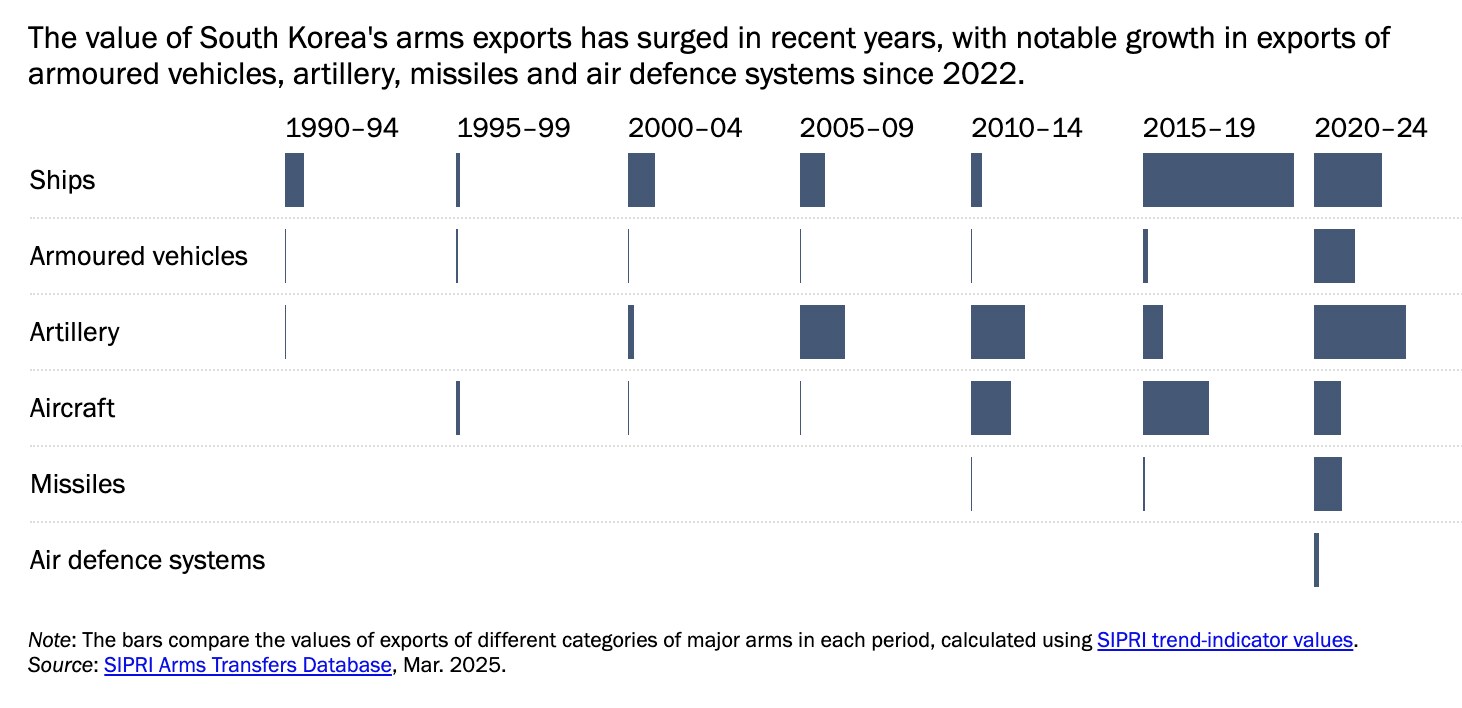
- South Korea is among the top ten largest weapons and defence equipment exporters according to SIPRI and exports doubled between 2010–14 and 2020–24.[20] In 2024 it accounted for 2.2% of global exports.
- By 2025, Korea was aiming to become the 4th largest arms exporter in the world[21] with a particular focus on Indonesia, New Zealand, Norway, Poland, Thailand and the United Kingdom. In 2022 it developed a framework agreement with Poland to supply weapons after Russia invaded Ukraine.[22]
- South Korean exporters work with recipient countries to transfer technologies and enable overseas production which encourages interoperability and strengthens its ties with NATO.[23]
- The South Korean government has accelerated support to exports with specific defence trade finance measures amounting to KRW 100bn in 2023[24] with an additional KRW 1tn (approx. $6.8bn) to expand its large scale cooperative finance programme between conglomerates, government and the financial sector.[25]
Finance
- SME loans are approximately 78.6% of total business lending while government guarantees constitute around KRW 90tn.
- Public lending schemes for SMEs are an important component of South Korea’s general industrial strategy. The Industrial Bank of Korea (IBK) represents a role model for this type of framework.[26]
- IBK backs government-prioritised industries and has announced some KRW 400bn for Defence with a specific focus on preferential loan terms for defence AI and defence SMEs. It is also issuing KRW 13bn for loan guarantees via the Korea Technology Finance Corporation (KIBO). The IBK preferential loans will reduce interest rates to SMEs by around 1.3%.[27]
- The IBK has a long history of working with multilateral organisations such as the Asian Development Bank — for example through the ESG successful management loan framework agreed in 2023.[28]
- South Korea’s Financial Services Commission provides regulatory oversight.[29] The Korean Development Bank was established to support national security and defence.[30]
- Korea has launched a cross-cutting Defence Investment Agency to encourage cooperation between the Ministries of Defence, SMEs and Science.[31]
- Using data up to 2024, the OECD suggests that South Korea’s financing for SMEs generally has shown signs of stress. Non-performing loans increased marginally and delays on average payment rates increased to just under 10 days.
- K-SURE — the Korean Trade Credit Insurance Corporation — alongside Korea EXIM Bank provides pre-emptive support to defence SMEs.[32]
- Korea’s defence competitiveness is not only industrial but financial as well. Work with international financial organisations allows it to scale finance beyond the national balance sheet.
Conclusions for DSRB
South Korea's macro-financial position provides an important backdrop to the assessment of defence SME financing constraints. The sovereign balance sheet remains comparatively sound, with general government debt at approximately 54.4% of GDP in 2026, though the IMF's April 2026 Fiscal Monitor has flagged that the pace of increase is among the fastest of comparable advanced economies, projecting a rise to 63% by 2031.[33] Borrowing costs remain manageable, with 10-year government bond yields in the mid-3% range.
Against this backdrop, three structural gaps define the case for DSRB engagement — each directly addressing limitations that domestic institutions cannot resolve alone.
Maturity mismatch
IBK's preferential loan programmes and Korea EXIM's export credit facilities, while extensive, are calibrated around commercial lending timescales. Defence programmes — particularly export and co-production arrangements involving technology transfer — operate over 10–20 year horizons that are structurally unsuited to domestic bank lending. A DSRB engagement would fill this gap by providing multi-year programme finance at rates that reflect the strategic value of the underlying investment rather than the short-term risk profile of the borrowing SME.
Multilateral credibility in third markets
Korean SMEs seeking to enter European or Middle Eastern supply chains as second- or third-tier suppliers face a challenge that domestic financing alone cannot address: prime contractors in those markets need assurance of partner quality, stability, and regulatory alignment that a Korean national institution acting unilaterally cannot provide. A DSRB co-investment signal functions as a multilateral quality endorsement, reducing the due diligence burden on overseas primes.
Counter-cyclical capacity
The OECD's most recent SME financing data for South Korea shows rising non-performing loans and increasing payment delays, reflecting persistent liquidity and cash flow pressures on SMEs. Because a multilateral instrument operates outside the domestic regulatory cycle governed by the Financial Services Commission, DSRB can act counter-cyclically — deploying patient capital when domestic credit conditions are tightening.Taken together, these three propositions define a role for DSRB that is genuinely additive rather than substitutive.
Appendix — research limitations
While South Korea benefits from relatively strong data availability across its defence and financial systems, several important gaps remain.First, there is limited publicly available data on defence-specific SME financing flows. While aggregate SME lending is substantial, there is no granular breakdown isolating lending to defence SMEs specifically.Second, there is a lack of detailed, publicly accessible data on SME participation within defence procurement. Although large firms account for approximately 80% of defence production, more granular data on SME participation by tier would enable a more precise understanding of where financing constraints are most acute.Third, evidence on pre-revenue and qualification-stage financing remains limited.Fourth, while South Korea has a sophisticated export finance architecture through institutions such as Korea EXIM Bank and K-SURE, there is limited transparency on the allocation of export credit and insurance specifically to defence transactions.Finally, there is limited integration of financial performance metrics with defence industrial outcomes.
References
- Jang Won-Joon and Song Jai-Pil (2020), KIET Industrial Economic Review, Sept-Oct 2020, current issue 2.
- SIPRI — Can the growth trend of South Korea’s arms industry last?
- Sang Chul Park and Pawel Pasierbiak (2026): “South Korean Defence Industry in the New Global Order and Implications for Poland” v2, Stosunki Miedzynarodowe / International Relations 2026 (revised 5 March 2026).
- Japan Times — South Korea defense startups surge (27 March 2026)
- SIPRI — Can the growth trend of South Korea’s arms industry last? (ibid)
- ELP Journal — chaebol structure
- Cambridge Journal of Asian Studies — Building bombs, building a nation
- ADM Eyes on Asia — South Korea eyes domestic tech start-ups
- Tomeczek, A.F. (2025) The Rise of the Chaebol: A Bibliometric Analysis of Business Groups in South Korea, J. Risk Financial Manag. 18, 658.
- SSRN paper on defence procurement
- ResearchSquare — SME defence financing
- War on the Rocks — South Korea’s growing role as a major arms exporter
- IISS — South Korea as a rising defence exporter (Dec 2025)
- Sang Chul Park and Pawel Pasierbiak (2026) (ibid)
- Reuters — South Korea to increase defence budget by 8.2% next year, President Lee says
- Defence Blog — South Korea approves defense budget increase
- SIPRI — Can the growth trend of South Korea’s arms industry last? (ibid)
- Ministry of SMEs and Startups — English announcement
- KoreaTechDesk — Korea SME R&D, defence, rare earth supply chains
- SIPRI arms transfers — top exporters
- SIPRI — Can the growth trend of South Korea’s arms industry last? (ibid). Note: this target is aspirational.
- War on the Rocks — South Korea’s growing role as a major arms exporter (ibid)
- Carnegie Endowment — Long-term NATO / South Korea defense ties
- SSRN paper on defence procurement (ibid)
- Biggo Finance — Korea cooperative finance programme
- Tariq Niazi, Junkyu Lee, Jae-Joon Han, Rebel Cole, and Sug Su Kim (2021): Public Lending Schemes for SMEs in Asia and the Pacific: lessons from South Korea and the United States. Asian Development Bank.
- GlobalTradeAlert — IBK Enterprise Bank provides KRW 400bn financial support for AI and defence industries
- OECD — Industrial Bank of Korea ESG Successful Management Loan
- Asia Insurance Review — South Korea FSC 24/7 monitoring taskforce
- KoreaTechDesk — KDB national growth fund, deeptech AI investment
- Seoul Economic Daily — Korea to launch Defense Investment Agency
- Seoul Economic Daily — K-SURE provides KRW 1.5tn pre-emptive financing
- KED Global — Korean economic overview